The Complete Guide to Retail Store Cleaning in Melbourne (2026)
Retail store cleaning in Melbourne covers floor maintenance (strip and seal, auto-scrubbing, carpet extraction), fitting room and display cleaning, shopfront window presentation, bathroom hygiene, shopping centre tenancy compliance (Westfield CoSupplier, Vicinity), WorkSafe Victoria OHS obligations, staff vs professional cleaning responsibilities, cleaning costs, and how to choose a retail cleaning contractor. Golden Star Retail Cleaning services retail stores across all Melbourne suburbs — nightly programs, periodic floor maintenance, and shopping centre contractor compliance included.
- What Is Retail Store Cleaning?
- What Does Retail Cleaning Include?
- Compliance — WorkSafe, Shopping Centre, Food Retail
- Cleaning Frequency — Every Zone Covered
- Floor Types and Maintenance Programs
- Equipment and Products
- Retail Store Cleaning Costs in Melbourne
- How to Choose a Retail Cleaning Contractor
- Retail Store Cleaning Checklists
- FAQ — 10 Questions Answered
1. What Is Retail Store Cleaning?
Retail store cleaning is the professional cleaning and maintenance of customer-facing commercial premises — including retail stores, boutiques, showrooms, shopping centre tenancies, and specialty retailers — to a presentation and compliance standard that supports the retailer's brand, maintains floor finish and surface condition over the tenancy life, meets WorkSafe Victoria OHS requirements, and (for food retail) complies with FSANZ food safety standards.
Retail store cleaning differs from office cleaning in its core focus: a retail store is a customer-facing presentation environment where the physical condition of the floor, window glass, display surfaces, and fitting rooms directly influences customer dwell time, purchase behaviour, and brand perception. Research on retail customer psychology consistently shows that store cleanliness is among the top three factors customers associate with brand quality — after product quality and staff behaviour.
In Melbourne, retail cleaning also has compliance dimensions that purely aesthetic cleaning does not: shopping centre leases impose minimum cleaning standards on tenants; WorkSafe Victoria OHS obligations require slip hazard management on retail floors; and for food retail (supermarkets, bakeries, food halls, delis), FSANZ food safety standards impose a regulatory compliance requirement on cleaning that non-food retail does not carry.
Golden Star Retail Cleaning provides professional retail cleaning services across all Melbourne suburbs — covering all retail venue types from single boutiques through to supermarkets and major shopping centre tenancies.
2. What Does Retail Store Cleaning Include?
A complete retail store cleaning program covers five distinct zones, each with specific cleaning requirements and maintenance programs.
Sales Floor
The sales floor is the primary retail cleaning zone — the largest area by square metre and the one most directly visible to customers. Sales floor cleaning includes: floor cleaning matched to floor type (auto-scrubber for large stores with vinyl or tile floors, damp mop for smaller stores with polished concrete or timber, vacuum for carpet tile); display fixture spot dusting; checkout counter cleaning and sanitising; signage and shelving wipe-down; and removal of all floor debris, tags, hangers, and packaging left by customers during trading.
For large-format retailers — supermarkets, homeware stores, department stores — auto-scrubber floor cleaning is not optional. A 2,000m² supermarket floor cleaned with a mop program rather than a ride-on auto-scrubber will show visible soiling within days. Auto-scrubber machines physically scrub the floor surface with rotating brushes and commercial cleaning solution, then recover the dirty water, leaving a clean, streak-free floor that mopping cannot achieve at large scale.
Fitting Rooms
Fitting rooms are the most labour-intensive zone per square metre in a retail store. Every cubicle requires: floor cleaning (sweep or vacuum, then mop or wipe); mirror cleaning (streak-free, top to bottom); hook and hanger bar wipe; bench or seat wipe; door handle and lock sanitising; and collection of all tags, pins, tissue, and other customer debris. In high-volume fashion retail with 10–20 fitting rooms, fitting room cleaning typically takes 20–35 minutes of the nightly clean.
Fitting rooms left partially cleaned — debris under benches, fingermarks on lower mirrors, dirty door handles — are noticed by customers at exactly the moment of highest purchase intent. The fitting room is where a customer decides whether to buy the item they are trying on; its presentation standard directly affects conversion rate.
Bathrooms
Customer bathrooms in retail stores require nightly professional cleaning and, in high-traffic stores, mid-day maintenance visits. Professional bathroom cleaning covers: toilet sanitisation with TGA-registered disinfectant; basin and tap sanitisation; mirror cleaning; floor sanitising (the highest cross-contamination risk surface in a customer bathroom); consumable restocking (soap and paper towels or dryer); bin emptying; and odour management. The consistent restocking of consumables is as important as the physical cleaning — a customer bathroom without soap or paper towels signals a negligent operator regardless of how clean the physical surfaces are.
Entry, Windows, and Shopfront
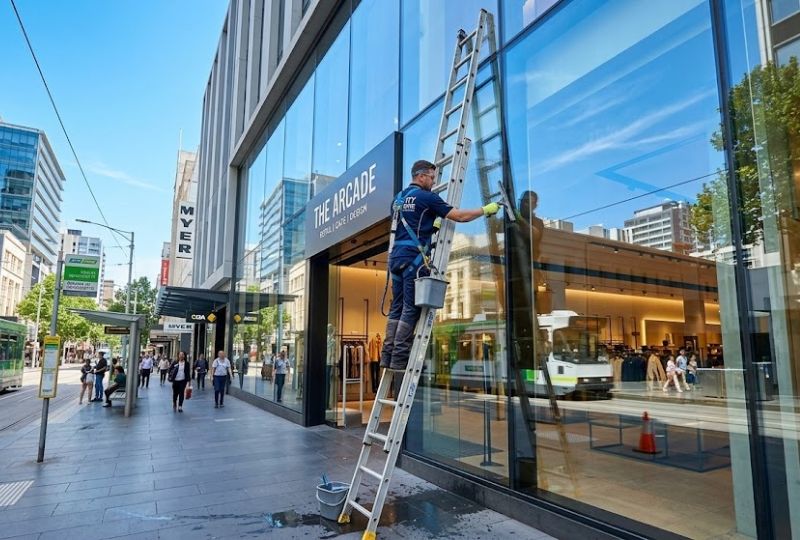
The shopfront is the first impression a customer forms of the store — and it forms that impression before they enter. Entry zone cleaning includes: door glass (interior and exterior); door handles and push plates; entry mat maintenance; entry floor cleaning including any soiling tracked in from outside; external shopfront paving immediately adjacent to the entry; and window cleaning for all customer-visible glass panels.
Professional shopfront window cleaning uses squeegee technique — not spray-and-wipe. Spray-and-wipe leaves streaks visible in angled light and does not remove the hard water deposits and environmental film that accumulate on external glass. Squeegee cleaning with a professional-grade solution and a channel squeegee produces the streak-free, optically clear glass that fashion retailers, jewellers, and homewares stores require for their display windows.
Stockroom and Back-of-House
Stockroom and back-of-house cleaning is the zone most commonly under-serviced in staff-only cleaning programs. A stockroom with accumulated dust on shelving, cardboard debris on the floor, and overflowing packaging waste creates OHS risks (trip hazards, pest harbourage) and affects the overall cleanliness standard of the store — pests attracted to stockroom debris do not stay in the stockroom. Weekly professional stockroom cleaning covers: floor sweep and mop; shelving wipe-down; all packaging waste removed; bins emptied; and any spills or damage reported.
3. Compliance — WorkSafe, Shopping Centres, and Food Retail
| Compliance Framework | Applies To | Key Requirement | Consequence of Non-Compliance |
|---|---|---|---|
| WorkSafe Victoria OHS Act 2004 | All retail stores | Floors maintained free of slip hazards; wet floor procedures in place; entry mat management in wet weather | WorkSafe improvement notice; personal injury claim liability |
| Shopping centre lease — presentation standard | All shopping centre tenancies | Tenancy maintained in clean and tidy condition consistent with the standard of the centre | Lease breach; centre management cleaning at tenant's cost |
| Westfield CoSupplier contractor registration | All contractors in Westfield centres | Cleaning contractor must be registered in CoSupplier before first visit | Contractor refused access; tenant in breach of contractor management obligations |
| Vicinity Centres contractor management | All contractors in Vicinity centres (Chadstone, Northland, Eastland, Emporium) | Cleaning contractor must be registered before first visit | Contractor refused access |
| FSANZ Standards 3.2.2 and 3.2.3 | Food retail only (supermarkets, bakeries, food halls, delis, cafe-retail) | Food contact surfaces cleaned and sanitised; food storage areas maintained in cleanable condition; HACCP documentation | Council Environmental Health improvement notice; prohibition order |
| Australian Consumer Law — acceptable quality | All retail stores | Store environment must not create unreasonable health or safety risk to customers | Consumer claim; liability for injury on premises |
WorkSafe Victoria — Retail Floor Slip Hazard Management
Under the Occupational Health and Safety Act 2004 (VIC), retail employers must provide and maintain a working environment that is safe and without risks to health. For retail floors, this means: maintaining floor finish in a non-slip condition; having wet floor procedures for spill response and entry mat saturation during wet weather; and ensuring entry mats are replaced before they become transfer surfaces rather than absorbents.
The most common WorkSafe-relevant cleaning failure in Melbourne retail stores is the vinyl floor that has lost its non-slip floor finish through neglect of the strip and seal program. A vinyl floor without a current floor finish coating is a slip hazard in wet conditions. The floor finish serves two purposes: presentation (sheen) and safety (non-slip properties). When the finish wears, both are lost. Quarterly strip and seal is not just a presentation maintenance program — it is an OHS compliance maintenance program.
Shopping Centre Contractor Management — What Tenants Need to Know
Every Melbourne shopping centre tenant who engages a cleaning contractor must ensure that contractor is registered in the relevant contractor management system before their first visit. This is not optional — unregistered contractors are refused access by centre security, leaving the tenant without a cleaning service for that night. Golden Star is registered with Westfield CoSupplier, Vicinity Centres' contractor management, Stockland contractor management, and all other major Melbourne shopping centre systems. Tenant clients do not need to manage contractor registration — Golden Star handles all compliance onboarding as part of the engagement.
4. Retail Store Cleaning Frequency — Every Zone Covered
| Zone / Task | Frequency | Method | Standard |
|---|---|---|---|
| Sales floor — vacuum (carpet tile) | Nightly | Commercial backpack or upright vacuum | Fibre condition maintenance |
| Sales floor — scrub (vinyl, tile, concrete) | Nightly | Auto-scrubber (walk-behind or ride-on) | Presentation + OHS slip standard |
| Fitting rooms — all cubicles | Nightly | Mop/wipe floor, squeegee mirror, sanitise handles | Presentation standard |
| Bathroom — full sanitise and restock | Nightly | TGA-registered disinfectant throughout | Presentation + OHS hygiene |
| Checkout counter clean and sanitise | Nightly | Surface cleaner + sanitiser on all contact surfaces | Customer touchpoint standard |
| Entry glass and door handles | Nightly (spot) + weekly (full) | Ammonia-free glass cleaner, microfibre | Presentation standard |
| Bins — empty and reline all | Nightly | All sales floor, bathroom, back-of-house | OHS + presentation |
| Full shopfront window clean | Weekly | Squeegee + professional solution, inside and out | Display presentation standard |
| Display shelving full dust | Weekly | Extension pole duster, wipe with microfibre | Display presentation standard |
| Stockroom floor and shelving | Weekly | Sweep, mop, wipe shelving | OHS + pest prevention |
| Low-level wall spot clean | Weekly | Surface cleaner on marked or soiled areas | Presentation standard |
| Floor buff and polish (vinyl) | Monthly | High-speed buffer + floor polish compound | Floor finish maintenance |
| Wall full clean and air vent dust | Monthly | Extension pole, damp wipe all surfaces | Presentation standard |
| Floor strip and seal (vinyl/VCT) | Quarterly | Strip with alkaline stripper, apply 3–4 coats seal | OHS slip standard + presentation |
| Carpet extraction (hot water) | Quarterly | Truck-mount or portable HWE machine | Fibre hygiene + appearance |
| Full building deep clean | Bi-annually | Ceiling, high walls, plant ledges, all surfaces | Tenancy condition maintenance |
5. Floor Types and Maintenance Programs
Floor type is the most significant variable in a retail store cleaning program — it determines the equipment required, the chemistry used, the maintenance schedule, and the long-term tenancy cost. Melbourne retail stores use the following floor types, each requiring a specific approach.
Vinyl / VCT
Most common in supermarkets, pharmacies, and large-format retail. Requires nightly auto-scrubber with pH-neutral cleaner, monthly buff, and quarterly strip and seal to maintain finish and non-slip properties. Strip and seal interval may be shortened to 8–10 weeks in very high-traffic areas (checkout aisles, entry zones).
Ceramic / Porcelain Tile
Common in fashion retail, food retail, and contemporary fitouts. Auto-scrubber nightly with neutral-alkaline tile cleaner. Grout lines require quarterly rotary brush deep clean with alkaline degreaser to prevent permanent darkening from foot traffic soiling. No strip and seal — seal coat on grout joints only.
Polished Concrete
Dominant in cafes-within-retail, boutiques, and creative-format retailers. Auto-scrubber with pH 6–8 concrete-specific cleaner — never alkaline above pH 10 (strips sealer). Resealing every 12–24 months depending on traffic. Looks premium but deteriorates fast if incorrect chemistry is used.
Carpet Tile
Standard in fashion boutiques, jewellers, and service retail. Nightly vacuum is the maintenance program — auto-scrubber is never used on carpet. Quarterly hot water extraction (HWE) removes embedded soiling and maintains colour consistency. Spot treatment of spills immediately (enzyme spotter for food/drink).
Timber / Engineered Timber
Premium boutiques, wine retailers, jewellers. Damp mop only with pH-neutral timber-specific cleaner — wet mopping warps both solid and engineered timber. Auto-scrubber is never appropriate. Annual maintenance coat (re-oiling or lacquer top-coat) maintains protective layer. Do not use steam cleaning — delamination risk on engineered products.
Natural Stone (Marble, Limestone)
Luxury retail, jewellers, premium homewares. Damp mop only with pH-neutral stone-specific cleaner — no acidic products under any circumstances (irreversible etching). Crystallisation or re-sealing annually. Highest-risk floor type for product misuse — a single application of the wrong chemistry can permanently damage a marble floor worth thousands of dollars per square metre.
The single most important rule for retail floor maintenance: pH-neutral cleaner as the daily maintenance product for any sealed or premium surface (polished concrete, stone, timber). Every floor deterioration issue Golden Star encounters in Melbourne retail tenancies at lease end traces back to the wrong cleaning chemistry — alkaline products stripping polished concrete sealer, acid cleaners etching stone, or abrasive products scratching porcelain tile glaze. If in doubt, use pH 7–8 and escalate to specialist products for periodic programs under professional guidance.
6. Equipment and Products
Key Equipment for Retail Store Cleaning
Auto-scrubbers are the most important equipment distinction between professional retail cleaning and staff-only programs. Walk-behind auto-scrubbers (typically 430–660mm scrub width) are appropriate for standard boutiques and retail stores. Ride-on auto-scrubbers are required for supermarkets, large-format retailers, and shopping centre common areas. Auto-scrubbers apply cleaning solution to the floor, scrub with rotating brushes under controlled pressure, then recover the dirty water in a single pass — producing a consistently clean floor that mopping cannot replicate at scale.
Squeegee window cleaning systems — a channel squeegee, T-bar applicator, and professional glass cleaning solution — are required for shopfront windows cleaned to display standard. Professional squeegee technique removes all water from the glass in a single, streak-free stroke. Water-fed pole systems (with purified water) are used for high-level external glass above squeegee reach.
Strip and seal equipment — a low-speed floor buffer with stripping pad, floor stripper (alkaline), wet vacuum (to recover the stripper slurry), and floor sealer applicator — is specialist retail maintenance equipment that is not part of a standard nightly cleaning kit. Strip and seal is a periodic restoration program, not a nightly task.
Products
The key product distinction in retail cleaning is between daily maintenance products (pH-neutral cleaners appropriate for sealed surfaces) and periodic treatment products (alkaline floor stripper for strip and seal, carpet extraction shampoo, carpet spotter, grout degreaser). Using periodic treatment products as daily maintenance products accelerates floor finish deterioration — particularly relevant with alkaline floor strippers, which should never be part of a regular daily program on any sealed surface.
For food retail components (supermarket food departments, bakery counters, deli sections), all products used in food preparation and storage areas must be APVMA-registered food-contact-safe. Standard commercial retail floor cleaners are not food-contact-safe and cannot be used on surfaces in food preparation areas without creating an FSANZ 3.2.2 compliance risk.
7. Retail Store Cleaning Costs in Melbourne (2026)
| Service | Cost Range (ex-GST) | Frequency |
|---|---|---|
| Small boutique nightly clean (under 150m²) | $80–$140 per night | Nightly (5–6 days) |
| Medium retail store nightly (150–400m²) | $140–$220 per night | Nightly (5–7 days) |
| Large retail store nightly (400–1,000m²) | $220–$420 per night | Nightly (5–7 days) |
| Supermarket nightly (1,000m²+) | $380–$900 per night | Nightly (7 days) |
| Weekly window clean (shopfront) | $60–$140 per visit | Weekly |
| Monthly floor buff and polish | $120–$280 per session | Monthly |
| Quarterly floor strip and seal (per 100m²) | $160–$280 per 100m² | Quarterly |
| Quarterly carpet extraction (per 100m²) | $120–$200 per 100m² | Quarterly |
| Bi-annual full building deep clean | $400–$1,200 per session | Bi-annually |
A typical Melbourne retail boutique (200m², vinyl floors, 6 fitting rooms, 1 bathroom) running a complete program — nightly clean 5 nights per week, weekly window, monthly buff, quarterly strip and seal — costs approximately $1,800–$3,200 per month ex-GST. The most accurate pricing is confirmed at a free site visit. Golden Star visits within 24 hours and provides a written fixed-price quote.
Call 0484 042 336 to arrange a free site visit for your Melbourne retail store.
Get a free quote for your Melbourne retail store
Site visit within 24 hours. Written quote. Shopping centre contractor compliance included. No lock-in.
8. How to Choose a Retail Cleaning Contractor in Melbourne
Choosing a retail cleaning contractor requires evaluating five specific criteria beyond general cleaning capability — criteria that directly affect whether the program delivers on its presentation, maintenance, and compliance objectives.
Retail-specific floor maintenance capability
Confirm the contractor has auto-scrubber equipment appropriate for your floor area and type; strip and seal capability (low-speed buffer, stripping pad, floor seal application); and carpet extraction for stores with carpet tile. A contractor without this equipment can clean the surface of your floor but cannot maintain the floor itself over the tenancy life.
Shopping centre contractor management registration
If you are a tenant in a major Melbourne shopping centre, confirm the contractor is already registered in the relevant system (Westfield CoSupplier, Vicinity, or other). Asking a contractor to register can take 2–4 weeks and delays your start date. Golden Star is pre-registered in all major Melbourne centre systems.
Public liability insurance at the required level
Standard Melbourne retail requires minimum $10M public liability. Shopping centres (Westfield, Vicinity) require $20M. Request a current certificate of currency before engagement and confirm the coverage level matches your lease and landlord requirements. Insurance certificates should be renewed annually — check the currency date.
Staff consistency and supervision
A retail cleaning program delivered by different staff each visit produces inconsistent results — the Monday crew cleans the fitting rooms thoroughly; the Friday crew misses two. Ask how the contractor assigns staff to retail clients (dedicated team vs rotating roster) and what supervision or quality check process exists. Golden Star assigns consistent teams to retail clients and conducts regular quality audits.
Food-safe products for food retail components
If your retail store has any food service or food retail component (cafe, bakery counter, deli, food court tenancy), confirm the contractor uses APVMA-registered food-contact-safe products in those zones and provides FSANZ HACCP-compliant cleaning documentation. This is a legal requirement, not an optional enhancement.
9. Retail Store Cleaning Checklists
Nightly Professional Clean Checklist
| Zone / Task | Method / Standard | Done |
|---|---|---|
| Sales floor — vacuum (carpet) or auto-scrub (hard floor) | Full floor area — no missed zones behind fixtures | |
| Fitting rooms — all cubicles floor, mirror, handles, bench | Streak-free mirror; sanitised handles; no debris under bench | |
| Bathroom — full sanitise, floor, basin, toilet, restock | TGA disinfectant; soap and paper towels restocked to full | |
| Checkout counter — wipe and sanitise all surfaces | Surface cleaner + sanitiser; card reader and belt cleaned | |
| Entry door glass — interior and exterior | Ammonia-free glass cleaner; streak-free | |
| All bins — empty and reline | Sales floor, bathroom, stockroom, back-of-house | |
| Display spot dust | Visible dust on forward-facing surfaces removed | |
| Any spills or damage — report to manager | Written note left + photo if significant |
Weekly Add-On Tasks
| Task | Method |
|---|---|
| Full shopfront window clean — all panels inside and out | Squeegee technique + professional glass solution |
| Full display shelving dust — all heights | Extension pole duster + microfibre wipe on forward surfaces |
| Stockroom floor and shelving | Sweep and mop floor; wipe shelving ledges |
| Low-level wall spot clean | Damp microfibre on any marked or scuffed areas |
| Entry mat inspect and rotate | Check mat condition; swap if showing wear or saturation damage |
Quarterly Periodic Programs
| Program | Floor Type | Duration | What It Achieves |
|---|---|---|---|
| Floor strip and seal | Vinyl / VCT | 3–6 hours (after hours) | Restores floor finish, non-slip properties, and appearance to near-new standard |
| Carpet hot water extraction | Carpet tile | 2–4 hours (after hours) | Removes embedded soiling, allergens, and odour; restores colour consistency |
| Polished concrete reseal assessment | Polished concrete | 4–8 hours (annual or bi-annual) | Confirms sealer integrity; reseals worn or abraded sections before full sealer failure |
| Full wall and ceiling clean | All stores | 2–4 hours (after hours) | Removes accumulated dust, cobwebs, and soiling from all heights including light fittings and air vents |
Staff Daily Maintenance (Between Professional Visits)
| Task | When | Time Required |
|---|---|---|
| Entry glass morning wipe (condensation or fingermarks) | Opening daily | 2 min |
| Bathroom consumable check and top-up | Opening + mid-trading | 5 min |
| Spill response — wet floor sign, absorb, dry | Immediately when required | 5 min |
| Fitting room quick clear between customers | During trading | 1 min per room |
| Entry mat swap (wet weather saturation) | When saturated | 3 min |
10. FAQ — Retail Store Cleaning in Melbourne
Most Melbourne retail stores above 100m² with customer bathrooms or vinyl/hard floors require nightly professional cleaning as the baseline. Boutiques under 100m² with carpet tile and no customer bathroom can run a weekly professional program with daily staff maintenance. All retail stores — regardless of size — require quarterly periodic programs: strip and seal for vinyl floors, hot water extraction for carpet tile, and periodic full window and wall cleaning.
Strip and seal is the process of removing the existing floor finish coating completely using an alkaline stripper, then applying multiple fresh coats of floor sealer to restore the floor's appearance and non-slip properties. It is required for vinyl and VCT floors — the most common floor type in Melbourne retail stores. Most Melbourne retail vinyl floors require strip and seal every 8–12 weeks, with the interval dependent on foot traffic volume and floor condition. A floor that looks dull and grey after cleaning, has black heel marks that don't clean off, or feels sticky after mopping needs strip and seal regardless of when it was last done.
Yes. If you operate a tenancy in any Westfield centre, your cleaning contractor must be registered in Westfield's CoSupplier contractor management system. For Vicinity centres (Chadstone, Northland, Eastland, Emporium Melbourne, and others), registration in Vicinity's contractor management portal is required. Unregistered contractors are refused access by centre security. Golden Star is pre-registered with both Westfield CoSupplier and Vicinity Centres, meaning tenants can engage Golden Star and have their contractor compliance covered without any registration delay.
Nightly retail cleaning costs $80–$420 per night depending on store size. A full monthly program for a medium Melbourne retail store (200–400m²) including nightly clean, weekly window, monthly buff, and quarterly strip and seal typically costs $1,800–$3,500 per month ex-GST. Larger stores and supermarkets scale above this range. The most accurate pricing requires a site visit — Golden Star provides a free site visit within 24 hours and a written fixed-price quote after every visit. Call 0484 042 336.
For very small boutiques under 50m² with no customer bathroom and carpet tile floors, staff cleaning supplemented by periodic professional window and carpet cleaning is feasible. For any retail store above 100m², with vinyl or hard floors requiring strip and seal, with customer bathrooms, or with fitting rooms, staff cleaning alone cannot maintain the standard required over a full retail tenancy. Floor finish deterioration begins within weeks on a vinyl floor without machine cleaning and strip and seal, and is visible to customers within months.
Walk-behind auto-scrubbers (430–660mm scrub width) are appropriate for retail stores up to approximately 800–1,000m². Ride-on auto-scrubbers are required for supermarkets and large-format retailers above this size where the time required to clean the floor with a walk-behind machine would exceed the available cleaning window. The auto-scrubber brush type (cylindrical vs disc) and pad hardness are matched to the floor type — softer pads for polished concrete and timber-look tile; harder pads for unglazed ceramic and epoxy. Golden Star specifies equipment per site during the site visit.
Four staff habits maintain professional clean standard between visits: immediate spill response (wet floor sign placed before the spill is absorbed — a WorkSafe obligation); entry mat monitoring in wet weather (swap a saturated mat before it becomes a transfer surface); fitting room debris clear between customers (30-second check removes tag and pin debris that accumulates visit-by-visit); and opening glass wipe (a microfibre kept at the service desk removes overnight condensation fingermarks from entry glass in 2 minutes). These four habits account for most of the presentation deterioration between professional visits in Melbourne retail stores.
Polished concrete retail floors require: nightly auto-scrubber cleaning with a pH 6–8 concrete-specific cleaner (never alkaline above pH 10 — strips the sealer); no strip and seal (polished concrete does not use a surface floor finish like vinyl — the sealer is impregnating); and periodic resealing every 12–24 months when the sealer shows wear (surface is absorbing liquid rather than beading it; appears dull after cleaning). The most common polished concrete maintenance failure in Melbourne retail is using the same alkaline floor cleaner as on the vinyl floor in the stockroom — this progressively strips the polish and dull finish appears within months.
Yes. Golden Star Retail Cleaning is registered with Westfield CoSupplier, Vicinity Centres contractor management, and all other major Melbourne shopping centre contractor management systems. We service retail and food tenancies inside Westfield (Doncaster, Southland, Knox, Airport West, Fountain Gate, Plenty Valley, and all other Melbourne Westfields), Vicinity Centres (Chadstone, Northland, Eastland, Emporium Melbourne, Box Hill Central, Broadmeadows Central, and others), Stockland centres, and all Melbourne CBD and suburban shopping centres.
A retail cleaning contract should specify: nightly cleaning scope (every zone listed explicitly — sales floor, fitting rooms, bathroom, checkout, bins, entry glass); periodic programs (frequency and scope of window cleaning, monthly buff, quarterly strip and seal, carpet extraction); pricing (fixed per-visit rate, not hourly); staff consistency commitment; quality check process; insurance coverage level; notice period for changes or cancellation; and (for shopping centre tenancies) confirmation that the contractor is registered in the relevant contractor management system. Golden Star provides a written service agreement covering all of these elements — no hidden charges, no lock-in minimum term.
Related guides: Daily vs Weekly vs Monthly Retail Cleaning · Floor Type Guide for Retail · Retail Cleaning Cost Melbourne · Do I Need a Professional Cleaner? · All Cleaning Guides