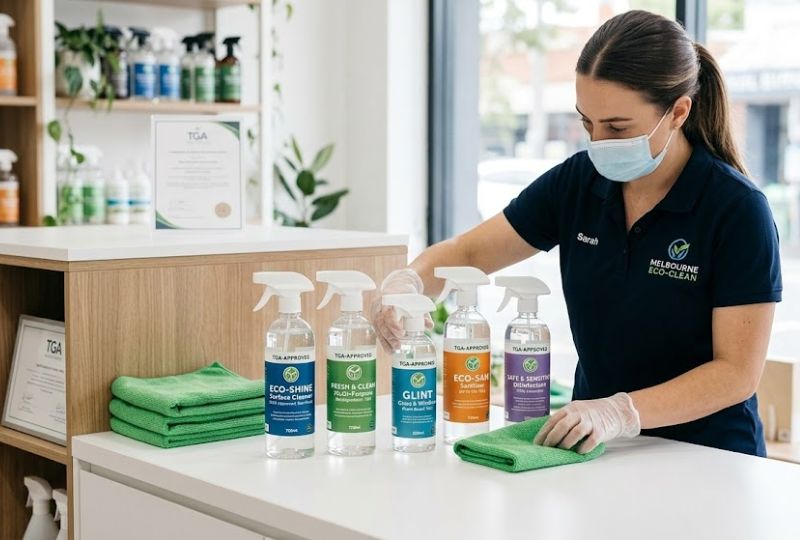
What Is HACCP Cleaning? — Food Safety Compliance Explained
HACCP (Hazard Analysis and Critical Control Points) cleaning is a systematic, documented approach to food safety that identifies hazards in food handling and applies control measures — including cleaning procedures — at critical points where contamination could occur. In Melbourne commercial kitchens, HACCP cleaning requires documented cleaning schedules, verified completion records signed by the responsible person, correct product selection for each surface type, and corrective action records. FSANZ Standard 3.2.2 applies HACCP principles to all Melbourne food businesses.
Key Points
Key Points
- HACCP is not a single standard but a systematic framework — FSANZ Standards 3.2.1, 3.2.2, and 3.2.2A all apply HACCP principles to different aspects of food premises cleaning
- HACCP cleaning documentation — signed completion records — is assessed by Melbourne council Environmental Health inspectors as evidence that the food safety system is operational, not just documented on paper
- The 6 elements of HACCP cleaning documentation are: cleaning schedule, written procedures, completion records, corrective action records, verification evidence, and SDS register
- Golden Star Retail Cleaning provides FSANZ-compliant HACCP cleaning documentation after every professional food premises cleaning session at no additional charge
- FSANZ 3.2.2A (effective December 2023) requires a nominated Food Safety Supervisor in addition to the HACCP cleaning program — cleaning contractors working in food premises are covered by this requirement
What Is HACCP Cleaning?
HACCP (Hazard Analysis and Critical Control Points) cleaning is a systematic, documented approach to food safety that identifies biological, chemical, and physical hazards in food handling and applies control measures — including cleaning procedures — at the critical points where contamination is most likely to occur.
In the context of commercial kitchen and food premises cleaning in Melbourne, HACCP cleaning means: identifying which surfaces and equipment are critical control points (food contact surfaces, storage areas, drainage); specifying the correct cleaning procedure for each (what product, at what dilution, for what contact time); assigning responsibility (who performs the task); and recording completion (signed completion record with date, task, and person responsible).
FSANZ Standard 3.2.1 (Food Safety Programs) requires food businesses in certain categories to have a documented food safety program that includes HACCP principles. FSANZ Standard 3.2.2 (Food Safety Practices and General Requirements) applies to all food businesses and requires cleaning and sanitising of food contact surfaces. FSANZ Standard 3.2.2A (Food Safety Management Tools) requires a nominated Food Safety Supervisor.
| HACCP Cleaning Element | What It Requires | Evidence for Inspection |
|---|---|---|
| Cleaning schedule | Written list of what is cleaned, how often, and by whom | Document on file, current and signed |
| Cleaning procedure | Method, product, dilution, contact time, PPE for each task | Written SOP for each cleaning task |
| Completion records | Signed record confirming each task was completed, date, time, person | Daily signed log — inspectors review at least 3 months of records |
| Corrective action records | Record of what was done when cleaning was not completed or standard not met | Corrective action log with date and resolution |
| Verification | Evidence that cleaning is effective — visual inspection, ATP testing, or third-party audits | Inspection records, professional cleaner completion sheets |
| Product SDS register | Safety Data Sheets for all cleaning chemicals used on premises | SDS folder accessible to all cleaning staff |
What HACCP Cleaning Documentation Does Golden Star Provide?
Golden Star Retail Cleaning provides HACCP-compliant cleaning documentation after every professional cleaning session in food premises — zone-by-zone completion records signed by the cleaning technician, noting the date, time, areas cleaned, and products used. This documentation is formatted for acceptance by Melbourne council Environmental Health inspectors across all Melbourne LGAs. No additional charge for documentation — it is included in all food premises cleaning programs.
Need professional cleaning for your Melbourne venue?
Free site visit 24 hours. Written quote. No lock-in contracts.
FAQ
FSANZ (Food Standards Australia New Zealand) is the regulatory body that sets Australia's national food safety standards — FSANZ Standards 3.2.1, 3.2.2, and 3.2.2A are the key standards for food premises cleaning. HACCP (Hazard Analysis and Critical Control Points) is the systematic food safety management approach that the FSANZ standards require food businesses to apply. FSANZ is the standard; HACCP is the methodology for meeting it.
FSANZ Standard 3.2.2 (which requires cleaning and sanitising of food contact surfaces) applies to all food businesses in Melbourne. FSANZ Standard 3.2.1 (which requires a formal food safety program based on HACCP principles) applies to specific higher-risk food businesses as defined by the Food Act 1984 (VIC). Most Melbourne restaurants, cafes, and food retailers operate under 3.2.2 at minimum. Melbourne council Environmental Health inspectors assess compliance with both standards during food premises inspections.
Yes — a cleaning contractor working in a food premises is operating within the HACCP food safety system and must understand the requirements relevant to their tasks: which surfaces are food contact (and therefore require sanitising, not just cleaning), the correct product dilutions, colour-coded equipment protocols to prevent cross-contamination, and how to complete cleaning documentation that forms part of the HACCP record trail.
Melbourne council Environmental Health inspectors assess cleaning documentation as a standard component of food premises inspections under the Food Act 1984 (VIC). Inspectors typically review at least 3 months of cleaning records — looking for consistent daily and weekly completion, signed records, and evidence that the cleaning schedule is being followed in practice (not just existing as a written document). Gaps in records or unsigned forms are cited as compliance deficiencies.
See also: All cleaning services · Pricing guide · More guides