Shopping Mall Cleaning Checklist — Common Areas, Food Court & Bathrooms
A Melbourne shopping centre cleaning program is divided into three zones with different responsibility allocation: centre common areas (walkways, escalators, lifts, bathrooms, car parks) managed by centre management through their primary contractor; food court common areas (shared dining tables, floor, waste stations) also managed by centre management but cleaned more intensively; and individual tenancies cleaned by each tenant through their own engaged contractor. The most common misconception among Melbourne shopping centre tenants is that the centre's cleaning contractor handles their shop interior — it does not. Every tenant is responsible for engaging their own contractor for their tenancy cleaning.
Key Points
Key Points
- Centre management's cleaning contractor covers common areas only — every individual tenancy (retail, food, or service) must engage their own cleaning contractor for their interior
- Food court common dining areas (tables, chairs, floor, waste stations) are centre management's responsibility — individual food tenancy interiors are each food operator's responsibility
- All cleaning contractors working in Melbourne's major shopping centres must be registered in the relevant contractor management system: Westfield CoSupplier for Westfield centres, Vicinity's contractor management for Eastland, Northland, Chadstone, and others
- Food tenancies in shopping centres require FSANZ-compliant cleaning documentation for council food safety inspections — the same HACCP records required of standalone restaurants
- Golden Star is already registered with Westfield CoSupplier, Vicinity Centres, and all major Melbourne shopping centre contractor management systems — tenants can engage Golden Star without managing centre compliance themselves
Guide — Shopping Centre Cleaning: Common Areas, Food Court & Bathrooms
A Melbourne shopping centre cleaning program operates across three distinct zones — each with different cleaning frequency requirements, responsibility allocation, and compliance standards. Understanding which zone is managed by centre management and which is the individual tenant's responsibility is essential for both centre management contractors and individual tenants engaging their own cleaning programs.
Zone 1: Centre Common Areas
Common area cleaning is centre management's responsibility — engaged through the centre's primary cleaning contractor and funded through common area maintenance (CAM) charges passed to tenants via their lease. This covers: all walkway and mall floor areas, escalators and lifts, centre bathrooms and baby change rooms, centre entry and exit points, parking structure common areas, and external facade and entry paving.
Zone 2: Food Court Common Areas
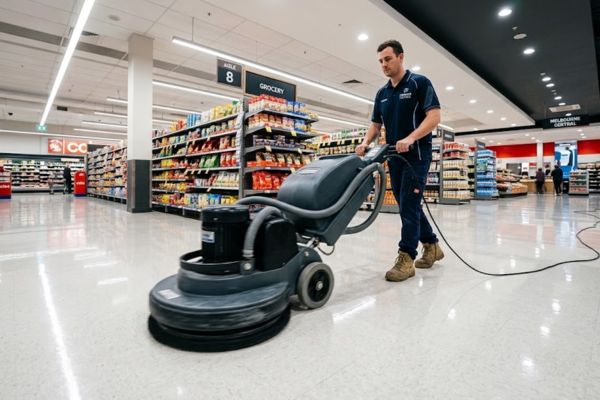
The food court is technically a common area managed by centre management, but its cleaning intensity is significantly higher than general mall walkways — shared dining tables, chairs, waste stations, tray return points, and the food court floor all accumulate food and beverage soiling that requires both nightly deep cleaning and daytime maintenance visits to maintain standard. Most Melbourne shopping centres use auto-scrubber floor programs for food courts given the floor area and soiling intensity.
Zone 3: Individual Tenancies
Individual tenancy cleaning — the interior of each retail shop or food outlet — is the tenant's sole responsibility. The centre's cleaning contractor does not clean inside individual shops. Every retailer, food operator, and service tenant must engage their own cleaning contractor for their tenancy interior.
| Area | Responsibility | Frequency | Method | Notes |
|---|---|---|---|---|
| Mall walkway floors | Centre management | Nightly | Auto-scrubber + spot mop during day | Daytime attendant for spills |
| Escalator treads & handrails | Centre management | Nightly | Manual scrub + handrail wipe | High-touch — sanitise handrails |
| Lifts — interior + buttons | Centre management | Nightly | Full interior clean, button sanitise | Daily inspection recommended |
| Centre bathrooms | Centre management | Nightly + daytime | Full sanitise nightly; attendant checks daytime | Consumable restock every visit |
| Food court dining tables & chairs | Centre management | Nightly | Sanitise all table surfaces; wipe chairs | Also cleaned during trading (attendant) |
| Food court floor | Centre management | Nightly | Auto-scrubber with appropriate chemistry | Grout quarterly deep clean |
| Waste stations (food court) | Centre management | Nightly + daytime | Empty, sanitise, reline; sort recycling | High-volume — multiple daytime empties |
| Car park — common areas | Centre management | Weekly + monthly pressure | Sweep nightly; pressure clean monthly | Oil stain pre-treatment for pressure clean |
| External entry paving | Centre management | Weekly pressure clean | Pressure wash; gum removal | Council footpath permit may apply |
| Individual retail tenancy | Tenant | Nightly | Floor, surfaces, bathroom, bins | Tenant engages own contractor |
| Food tenancy interior + kitchen | Tenant | Nightly + weekly deep | FSANZ-compliant program + HACCP docs | Tenant engages own FSANZ contractor |
| Tenancy boundary strip | Shared / confirm with lease | Nightly | Coordinate between tenant and centre | Confirm boundary in lease schedule |
Action Steps — What Individual Tenants Need to Do
Individual tenants in Melbourne shopping centres often assume — incorrectly — that the centre's cleaning contractor handles their shop interior. This misconception leads to shops that are only cleaned if the centre contractor accidentally enters, or that are cleaned by the tenant's own staff to an inadequate standard. The lease is unambiguous: the centre's cleaning contractor manages common areas, and the individual tenancy cleaning is the tenant's sole responsibility under the lease.
The practical steps for a Melbourne shopping centre tenant engaging a cleaning contractor:
Step 1 — Identify your centre's contractor management system. Major Melbourne centres use: Westfield CoSupplier (all Scentre Group / Westfield centres), Vicinity Centres' contractor management portal (Chadstone, Northland, Eastland, Emporium Melbourne and others), or their own centre-specific system. Any cleaning contractor you engage must be registered in the relevant system before their first visit.
Step 2 — Confirm your scope. Check your lease for the exact tenancy cleaning obligations — most retail leases require the tenant to maintain the tenancy in a clean and tidy condition consistent with the standard of the centre. For food tenants, FSANZ cleaning documentation is an additional lease obligation in most Melbourne centre food court leases.
Step 3 — Engage a contractor already registered. Golden Star is registered with Westfield CoSupplier, Vicinity Centres' contractor management, and all major Melbourne shopping centre systems. Engaging us means you skip the contractor registration process entirely — we're already compliant and can start within days of engagement.
Need professional cleaning for your Melbourne venue?
Free site visit within 24 hours. No lock-in contracts. All Melbourne suburbs.
FAQ
The individual tenant is entirely responsible for cleaning inside their shop. The centre's cleaning contractor manages common areas — walkways, bathrooms, escalators, food court tables and floors, and car parks. They do not enter or clean individual tenancies. Every retail tenant and food operator must engage their own cleaning contractor for their tenancy interior. This is specified in virtually every Melbourne shopping centre retail lease.
Common area cleaning is managed by centre management through their primary cleaning contractor, funded by common area maintenance charges in tenant leases. It covers all shared infrastructure: walkways, bathrooms, escalators, lifts, car parks, food court common areas, and external entries. Tenancy cleaning is the individual tenant's responsibility for the interior of their own leased space — floors, surfaces, display areas, bathrooms (if the tenancy has its own bathroom), and the fitting room or kitchen area depending on the tenant type. The two programs are completely separate.
Yes. All contractors working in any capacity inside a Westfield centre in Melbourne must be registered in the Westfield CoSupplier contractor management system. This includes cleaning contractors engaged by individual tenants. Registration requires current public liability insurance at the level specified by Westfield, a completed contractor induction, and any other centre-specific requirements. Golden Star is registered with Westfield CoSupplier and can service Westfield tenancies across all Melbourne Westfield locations without the tenant needing to manage contractor registration themselves.
Food court floors should be auto-scrubbed nightly — the food and beverage soiling from a full day of food court trading requires machine cleaning, not just mopping. During trading hours, a daytime attendant program handles spills and maintains the floor appearance between the nightly program. Tile grout in food courts requires a quarterly rotary brush deep clean to prevent permanent grease staining. For centre management programs, Golden Star provides auto-scrubber floor cleaning, grout quarterly deep clean, and daytime attendant programs for Melbourne shopping centre food courts.
See also: All cleaning services · Compliance resources · More cleaning guides